


Introduction
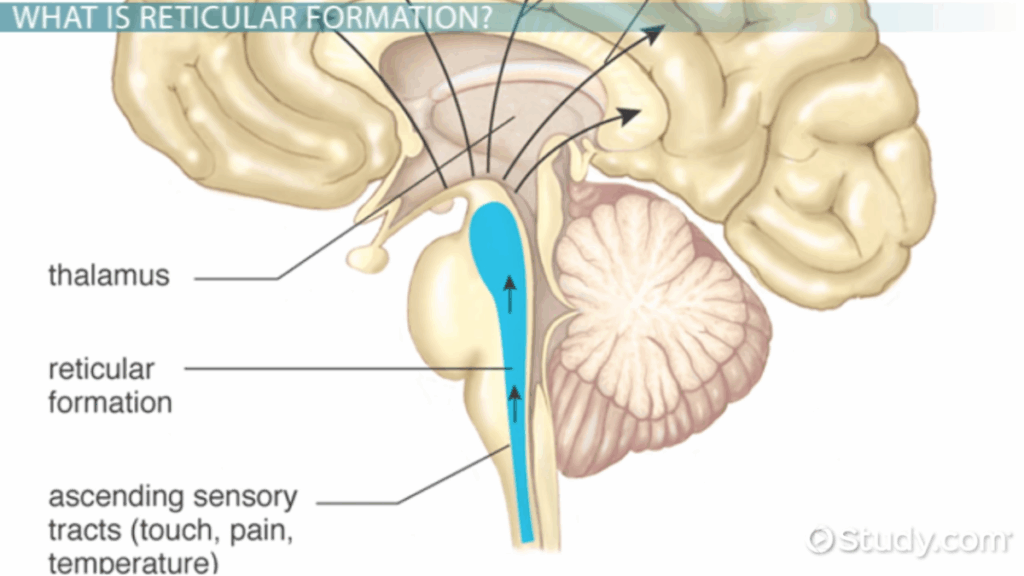
When we think of brain function, most people immediately picture the cerebral cortex, the seat of higher thinking and cognition. However, a less conspicuous but critical structure lies deep within the brainstem the reticular formation (RF). Unlike the sharply defined structures of the cortex, the RF is a diffuse network of interconnected neurons spanning the midbrain, pons, and medulla. This intricate system regulates arousal, attention, consciousness, motor control, and vital autonomic processes, making it indispensable for both basic survival and complex behavior.
Despite its subtle presence, the RF serves as the brain’s control center, coordinating signals from the body and environment to ensure smooth functioning. This article explores the RF’s anatomy, functions, pathways, clinical relevance, and why it is central to understanding brain health.
Anatomy of the Reticular Formation
Structure Overview
The reticular formation is composed of a loosely arranged network of neurons and nuclei embedded within the brainstem. Its name, “reticular,” comes from the Latin reticulum, meaning net like, reflecting its intricate, mesh like architecture. Unlike well delineated nuclei, the RF’s neurons are distributed across the brainstem’s central core, intermingling with cranial nerve nuclei and ascending/descending tracts.
Neuroscientists categorize the RF into three main columns:
-
Median (raphe) column: Produces serotonin, which plays a role in mood regulation, arousal, and sleep.
-
Medial (gigantocellular) column: Houses large neurons involved in motor coordination and posture control.
-
Lateral (parvocellular) column: Contains smaller neurons responsible for autonomic and visceral regulation, including breathing and heart rate control.
Connectivity and Pathways
The RF is a central communication hub, connected through both ascending and descending pathways:
-
Ascending pathways (Reticular Activating System, RAS): Project to the thalamus, hypothalamus, basal forebrain, and cerebral cortex. These connections regulate wakefulness, attention, and sensory prioritization.
-
Descending pathways: Extend to the spinal cord and cranial nerve nuclei, influencing muscle tone, posture, reflexes, and autonomic control.
This bidirectional connectivity allows the RF to coordinate cortical activity with physiological responses, maintaining a balance between brain and body.
Functions of the Reticular Formation
The reticular formation serves multiple critical roles, ranging from basic survival to higher-level cognitive functions.
1. Regulation of Wakefulness and Consciousness
The RF, particularly through its ascending RAS pathways, plays a central role in maintaining consciousness. It continuously sends excitatory signals to the cortex, promoting alertness and responsiveness. During non-REM sleep, these signals diminish, allowing synchronized slow-wave cortical activity.
Disruption of the RF, particularly its ascending connections, can result in coma or severe impairment of consciousness, even if the cortex itself is structurally intact. This demonstrates the RF’s essential role as a gateway to wakefulness and awareness.
2. Attention and Sensory Filtering
Another key function of the RF is modulating attention. It acts as a sensory gatekeeper, filtering irrelevant stimuli while prioritizing important sensory information. For example, while walking in a crowded city, your RF helps you focus on a conversation with a friend and ignore background noise or visual distractions.
By controlling which inputs reach conscious processing, the RF helps prevent sensory overload, allowing efficient cognitive function and adaptive behavior.
3. Motor Coordination and Postural Control
The descending projections of the RF, including reticulospinal tracts, are essential for regulating muscle tone, posture, and reflexes. They integrate information from the vestibular system, proprioceptive feedback, and vision to coordinate smooth, adaptive movements.
This function is crucial for balance, walking, and adjusting posture in response to sudden changes. For instance, catching yourself after tripping or shifting weight while standing relies heavily on RF activity.
4. Autonomic and Visceral Regulation
The RF also manages vital autonomic processes. Its nuclei influence respiration, heart rate, and blood pressure, coordinating reflexes like swallowing, coughing, and vomiting. By interacting with the hypothalamus and spinal cord, the RF ensures homeostasis keeping internal conditions stable despite environmental changes.
5. Pain Modulation
Pain perception is another area where the RF exerts influence. It participates in both ascending nociceptive pathways and descending inhibitory systems, regulating how pain signals are transmitted and perceived. This allows the body to respond appropriately to harmful stimuli and integrate pain with autonomic and reflexive reactions.
Clinical Significance
Due to its central role in consciousness, movement, and autonomic regulation, RF dysfunction can have serious consequences:
-
Consciousness Disorders: Damage to ascending RF pathways can lead to coma or vegetative states.
-
Sleep and Attention Deficits: Dysfunction may result in insomnia, hypersomnia, or attention impairments.
-
Motor Impairments: Disruption of descending pathways can cause postural instability, impaired gait, or reduced muscle tone.
-
Autonomic Dysregulation: Breathing, heart rate, and other visceral functions may be compromised.
-
Pain Disorders: Altered RF function may change pain perception or reduce natural pain inhibition.
Recognizing RF dysfunction is crucial in critical care, neurology, and rehabilitation, as it can impact both life-sustaining functions and higher-order brain processes.
Research and Advances
Despite decades of study, the RF remains complex and challenging to map. Its diffuse organization and overlapping projections make isolation and functional studies difficult. However, modern neuroimaging, electrophysiology, and pharmacological research continue to reveal new insights into RF function:
-
Its role in attention and cognitive control is being investigated for ADHD and other attention disorders.
-
Research explores RF influence on sleep regulation and circadian rhythms, providing insight into sleep disorders.
-
Studies link RF neurotransmitter systems to mood regulation, stress responses, and neurodegenerative conditions, such as Parkinson’s disease.
Continued research underscores the RF’s essential contribution to both neurological health and behavioral regulation.
Conclusion
The reticular formation is more than just a “brainstem structure” it is a master integrator. It connects the brain’s sensory, motor, and autonomic networks, regulating wakefulness, attention, posture, and vital body functions. Without the RF, higher-level cognition, reflexive responses, and essential physiological processes would be impossible.
From waking up in the morning, to focusing in a noisy environment, to maintaining balance, breathing, and responding to pain, the RF orchestrates countless processes behind the scenes. Its subtle but profound influence underscores why neuroscientists consider it one of the most critical yet underappreciated neural networks. Understanding the RF provides not just anatomical knowledge but insight into how consciousness, attention, and survival are seamlessly integrated in the human brain.
FAQ
Q1: What is the difference between the reticular formation and the reticular activating system (RAS)?
A: The RF is the broad network of neurons in the brainstem, while the RAS refers to the ascending pathways within the RF that regulate arousal and wakefulness.
Q2: How does the RF influence attention?
A: It acts as a sensory filter, prioritizing important stimuli and suppressing irrelevant information, which allows focused attention without sensory overload.
Q3: Can RF damage affect movement?
A: Yes. The descending pathways of the RF control posture, balance, and reflexes. Damage may impair coordination or cause muscle weakness.
Q4: Which neurotransmitters are involved in RF function?
A: Key neurotransmitters include acetylcholine, norepinephrine, serotonin, dopamine, and glutamate, which modulate cortical and autonomic activity.
Q5: Why is the RF difficult to study?
A: Its diffuse structure, overlapping nuclei, and extensive connections make it challenging to isolate experimentally. Its modulatory role also complicates functional mapping.
for more information click here
